


Products Description
This double cage construction hoist is built for high-frequency vertical transport on medium to high-rise projects. Driven by a rack-and-pinion system with dual independent motors, it delivers a rated load of 2,000 kg per cage, reaching speeds up to 63 m/min.
The safety gear is old-school mechanical. No circuit boards deciding when to stop. Centrifugal governor, steel brake cone, manual door pins - that stuff actually works when dust gets everywhere. Gear teeth are carburized. Hardness around 58 Rockwell. Should last.
Installation is easier than the old models. Sections bolt together with standard tools. And the wear points are visible without crawling underneath - you check them from the ground, takes two minutes.
Industry Applications
This hoist shows up on sites where the crane is already booked solid. High-rise housing projects, for example - the crane spends most of its day swinging pre-cast panels and rebar bundles. The hoist takes over the rest. Concrete buckets, small toolboxes, welding machines, shift crews. That keeps the crane from getting tied up with light loads.
The twin-cage layout makes a real difference on power plant chimneys and industrial silos. One cage handles inspectors and their gear. The other carries grout hoses and patch material for concrete repairs. Both run off the same mast but don't interfere with each other.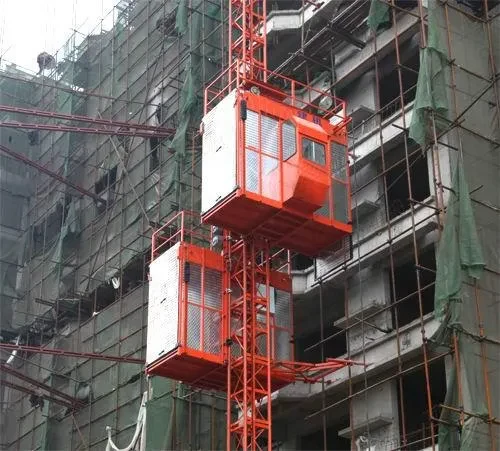
Bridge foundations are another fit. You sink the mast on a temporary platform next to the pier. The hoist runs tools down to the caisson workers and hauls core samples back up. It does this without blocking the main deck above. On mining headframes, the same unit serves as backup access when the main skip is being serviced. The sealed gearbox holds up well in that dusty environment.
Construction Cases
The Kuala Lumpur job was tight. One access lane. Two cranes already booked for panels and rebar. We put the hoist on the north side and ran drywall, pipe stacks, and the 18-man crew through it. One cage cycled materials. The other carried workers. Floor-to-floor went from seven minutes to just under four. No issues with the drive unit across 14 months.
Chile - 3,500 meters elevation on a dam face. The hoist sits on a bolted steel platform, running 180 meters down to the diversion tunnel. Welders ride it every morning with their gear. We derated the cooling fans for thin air and recalibrated the brake. One door roller failed at 2,100 trips. Changed it in 45 minutes. Back in service the same shift.
Norway - two winters on a bridge anchor block. We boxed the hoist in plywood and tarps when the temperature dropped. Buffers worked fine at -18°C. The standard grease went stiff after a month, so we switched to a low-temperature grade. The mast racks stayed clear. The climbing speed pushes enough air to blow snow off the teeth.
After-sales Service
Industry standard practice typically offers a comprehensive warranty of 12 months (1 year) from the date of delivery or commissioning. For critical safety components, the safety arrester (anti-fall device) has a mandatory calibration validity period of 1 year and a total service life of approximately 5 years. Special attention must be paid to its regular inspection and replacement schedule.
Point 1: Warranty Period and What's Covered
The whole machine usually comes with a 1-year warranty. But here's something you really need to pay attention to – the safety arrester (the anti-fall device). This thing has to be inspected and calibrated every single year, and you must replace it after 5 years of use. That's a hard rule, not a suggestion. Don't cut corners on this – it's literally a lifesaver.
Point 2: What Kind of Service You Can Expect
A good supplier doesn't just sell you the equipment and walk away. They should stick with you for the long run. The basics include: making sure genuine spare parts are available when you need them, sending engineers to site for installation, debugging, and repairs, and teaching your people how to do routine maintenance. The better manufacturers offer 24-hour phone support. For overseas customers, from the time you report a problem to the time someone shows up on site, it's usually within a day or two.
Point 3: Get It in Writing, Not Just in Words
Here's the thing – don't rely on verbal promises. You need to get everything down in the contract before you pay: which parts are covered under warranty, what counts as wear-and-tear parts, who pays for shipping spare parts, and whether there's a charge for on-site service calls. As for the "Powerful" brand specifically, the most straightforward way to find out their exact after-sales policy is to go straight to your dealer and ask them to hand over the warranty certificate and service manual that come with the machine.
FAQS
Q1: Is repair completely free during warranty?
Not necessarily. The 1-year warranty only covers non-human damage to components. Wear parts (brake pads, cables, etc.) are not covered. Also, some suppliers cover parts only – labor and travel are extra. Ask before you sign.
Q2: How does the safety arrester get inspected?
It must be inspected and calibrated once a year, and replaced after 5 years. This must be done by a qualified agency or factory-authorized personnel – you can't use your own people. If you skip inspection and an accident happens, insurance won't pay and you're fully liable.
Q3: How soon can someone come if it breaks down?
They'll start with phone troubleshooting. If that doesn't work, they send someone to site. Domestically, it's usually within 48 hours. For international projects, it takes longer due to visas and flights – check your contract. Get the response time in writing, and agree on penalties for delays.
Hot Tags: powerful double cage construction hoist, China powerful double cage construction hoist manufacturers, suppliers, factory, Building Material Hoist, Conatruction Hoist Elevator, construction hoists, Dual purpose Construction Hoist, Material Lifting Equipment, Passenger And Material Hoists


