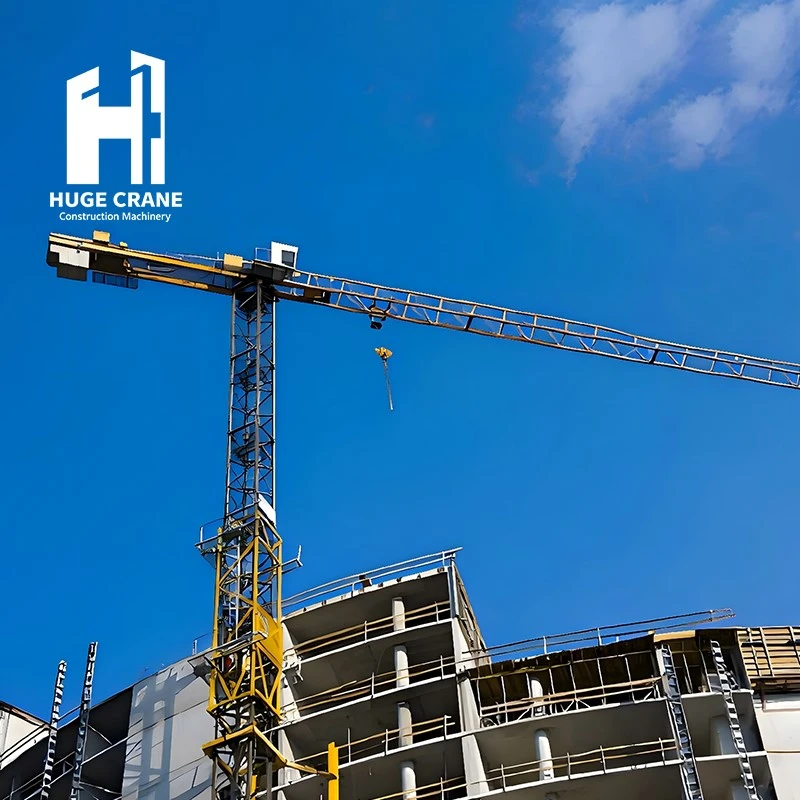


If you've ever stood at the base of a towering construction site, craning your neck to track the movement of a crane's boom high above, you might have noticed something striking: unlike their luffing-jib or hammerhead counterparts, flat top tower cranes sit with a sleek, uncluttered top-no giant rotating turret or weighty counter-jib visible. As a supplier of these specialized machines, I get asked this question all the time: how exactly do the tower sections of a flat top tower crane connect? It's a question that goes far beyond bolts and metal; it's the backbone of safety, stability, and the ability to reach the heights we build today.
To answer this, we first need to ground ourselves in what makes a flat top crane different from other models. Traditional cranes use a rotating turntable at the top of the tower to pivot the boom, with heavy counterweights on the opposite end to balance loads. Flat top cranes, by contrast, have a flat, open top structure where the boom is secured directly to the tower's upper section, with counterweights either tucked closer to the mast or integrated into the design. This streamlined design isn't just for looks-it makes them easier to transport, faster to assemble, and ideal for tight urban construction sites where multiple cranes might operate in close proximity. But that efficiency relies entirely on how each tower section fits together, piece by piece, to form a rigid, vertical structure that can hold hundreds of feet of height and tons of load.
Let's break down the connection process step by step. Every flat top crane is assembled on-site in stages, starting with the base, then adding tower sections (often called "mast sections") one by one until the crane reaches its desired height. The tower sections themselves are typically made of high-tensile steel, designed to withstand extreme lateral forces from wind, the weight of suspended loads, and the constant stress of rotating the boom. Each section is prefabricated with precision machined connection points, not random holes drilled in the shop. That's where the work starts even before on-site assembly: each mast section has two types of connection points: primary structural joints and load-bearing anchor points.
When we at our team set up a flat top crane (and I've led more than a dozen of these assemblies over the years), the first thing we do is prepare the ground base, which is either a reinforced concrete pad or a steel foundation for temporary sites. Once that's set, we lift the first full tower section into place using a mobile crane. That section has four vertical corners, each with a cast steel end collar-think of it as a thick, reinforced ring with precision-aligned bolt holes. The next section, lifted above it, has a matching end collar on its bottom end. To connect them, we don't just slide the collars together and tighten a few bolts; we use what's called a "pin and bolt" system that's been standardized for flat top cranes for over two decades. Wait, but not just any bolts-we use high-strength, galvanized steel bolts that are torque-controlled to exact specifications. A single tower section connection can use anywhere from 16 to 40 bolts, depending on the crane's lifting capacity. For example, our 7.5 Ton Flat Top Tower Crane For Building
Construction uses 28 bolts per tower section joint, because it's designed for mid-rise projects where wind and load forces are consistent but not extreme. That's a number that's non-negotiable-undertorqued bolts can cause the tower to shift under load, while overtorquing can snap the bolt or damage the collar, leading to catastrophic failure.
But here's what most people don't see: the connection isn't just between the two sections at the collars. Every 20 to 30 feet along the tower, there are additional horizontal support frames that bolt to the mast sections, creating a rigid "grid" that resists twisting. These frames, called cross-braces, are critical because they keep the tower from flexing when the boom is extended out to lift a load. On our Extended Height Flat-top Tower Crane, which is built for high-rise projects over 500 feet tall, these cross-braces are spaced every 15 feet to handle the increased wind shear at elevation. Without these secondary connections, even the tightest collar bolts can't prevent the tower from swaying in strong winds-a major safety risk for crews working hundreds of feet above ground.
Another key component of tower section connections on flat top cranes is the guide pin system. Unlike older cranes that rely entirely on bolt holes to align sections, our mast sections have precision-machined guide pins that fit into corresponding holes on the opposite collar. This might seem like a small detail, but it's one of the reasons flat top cranes are assembled faster than their traditional counterparts. When lifting a new section into place, the guide pins slide into the holes on the lower section, perfectly aligning all the bolt holes so our crew doesn't have to spend 20 minutes adjusting the section to get bolts to line up. That cuts assembly time by nearly half, which is a huge benefit for construction projects on tight schedules. For context, our Construction Tower Crane 6ton, designed for small to mid-sized projects like apartment buildings or retail centers, uses a 12-guide pin system to ensure fast, accurate alignment.
Safety is the biggest factor that drives how these connections are designed and maintained. Every bolt and every guide pin is inspected twice during assembly: once when the section is lifted into place, and again after all bolts are torqued. But it doesn't stop at the initial assembly-on every project, we have a scheduled maintenance checklist that includes retorquing tower section connections every 90 days, or after any event that could stress the tower, like a heavy wind storm or a sudden load drop. I once worked on a project where a sudden gust of wind hit during a load lift, shifting the tower slightly. Our crew checked all connections within an hour and had to retorque 8 bolts on the 12th section-small issue, but it's exactly why that process is non-negotiable.
What about when we need to extend the tower even further? Once a crane reaches its maximum base height, we add what's called "extension sections" or "split sections." These sections are lighter than the standard mast sections, because they're lifted by the crane itself (a process called "climbing"). When climbing, the crane's climbing frame locks onto the existing tower, and the operator lifts a new section from the ground, slides it into place, and connects it to the top of the current tower. The connection for these extension sections uses the same pin-and-bolt system, but with a reinforced collar that's designed to handle the additional bending force of the taller tower. For our A 10-ton Construction Crane For High-rise Buildings, which can reach over 800 feet, we use heavy-duty extension sections that connect with 42 bolts per joint, because at that height, even a minor misalignment can lead to dangerous sway.
A common misconception is that all flat top crane tower section connections are the same, but that's not true-they're tailored to the crane's lifting capacity and intended use. A small 2-ton flat top crane for a residential remodel has far simpler connections than a 10-ton crane for supertall skyscrapers. The diameter of the collars, the number of bolts, and the strength of the steel all change based on how much load the crane needs to lift and how tall it needs to go. That's why it's so important to use equipment designed for the specific project-using a crane with undersized connections for a high-rise is a recipe for disaster.
If you're working on a construction project and are looking for a reliable flat top crane, whether it's for a small site or a massive high-rise, it's worth understanding that the connection system is what makes the crane safe and functional. When you choose a crane from a trusted supplier, you're not just getting a machine that lifts heavy things-you're getting a system where every tower section is connected to exacting standards, designed to withstand the toughest conditions. Our Flat Top Tower Crane Equipment line includes everything you need for assembly and maintenance, from torque wrenches made specifically for crane connections to replacement collars and guide pins, so you can keep your crane running safely for years.
At the end of the day, the tower section connection of a flat top crane is a perfect mix of engineering precision and hands-on expertise. It's not just metal and bolts-it's the result of decades of refining designs to make construction safer, faster, and more efficient. If you're in the market for a flat top crane, whether you need a compact unit for a city block or a high-capacity crane for a skyscraper, I'd be happy to walk you through the details of our models and how their connection systems are tailored to your project needs. Reach out to our team to discuss your requirements and find the right flat top crane for your next job.