




Products Description
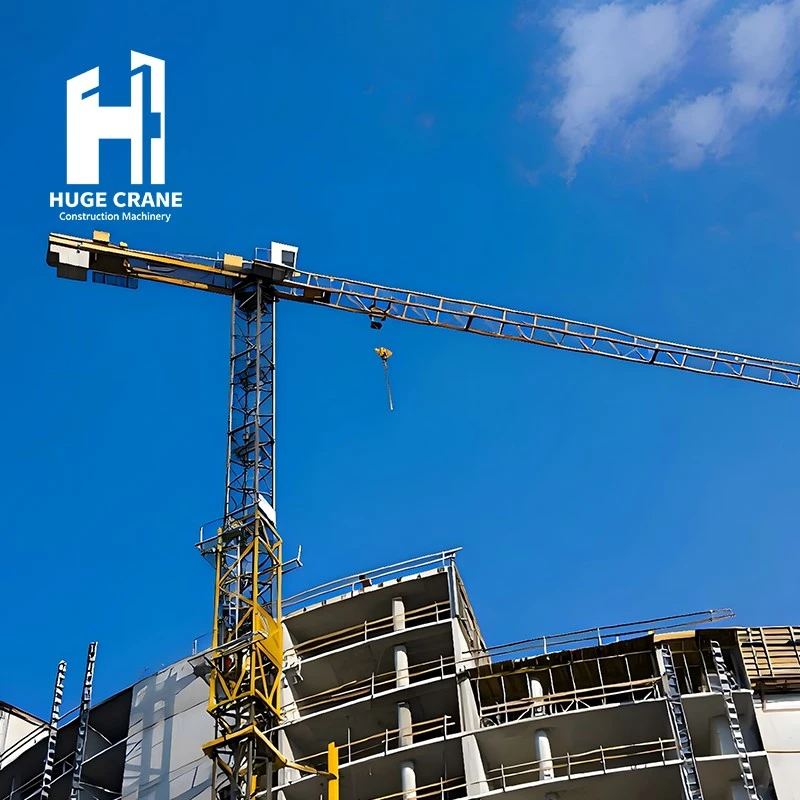
We developed this extended height flat-top tower crane as a practical topless lifting equipment targeted at high-rise construction and infrastructure jobs. Different from traditional types, it gets rid of the tower head structure and leaves sufficient space above the jib. It can effectively avoid crash risks when multiple cranes work together on compact building sites.
The tower mast sections are strengthened to realize higher free-standing height, cutting down the number of wall attachments required. After fitting anchor frames, the unit reaches a great lifting height for hoisting precast parts, steel frames and common construction materials. Buyers can select different jib lengths to satisfy varied working radius demands.
Frequency conversion systems control hoisting, trolleying and slewing, supporting stable operation and precise load placement. All necessary safety devices are equipped. Modular design simplifies on-site assembly, disassembly and container transport. Suitable for housing construction and bridge works, the machine complies with international standards. Custom solutions and long-term after-sales support are available for overseas purchasers.
Applicable Industries
1.High-rise residential & commercial building construction
2.Prefabricated component construction projects
3.Municipal infrastructure and bridge engineerin
4.Factory workshop construction and urban renewal projects
Construction Cases
Pinnacle SkyTower (Toronto, Canada)
Building: 110-story residential tower, 348 meters tall, tallest residential building under construction in Canada.
Crane used: Terex CTT 472-20t flat-top internal climbing crane.
Crane specs:
Jib length: 55 meters.
Tip load capacity: 6.24 tons.
Hoist power: 80 kW.
Max hoisting speed: 196 meters per minute.
Climbing system: Anchored with 16 internal climbing ties.
Outcome: Successfully climbed to full height of 348 meters, demonstrating flat-top cranes with internal climbing technology can handle super high-rise construction above 300 meters.
Zugspitze Eibsee Hotel Project (Germany)
Site challenges: Ecologically protected area with tight construction spaces due to trees and existing buildings.
Crane used: Liebherr 370 EC-B 12 Fibre flat-top tower crane.
Crane specs:
Jib length: 70 meters for obstacle clearance and extended reach.
Lifting capacity: 4.1 tons at 70-meter radius using high-performance fiber rope technology.
Performance improvement: Approximately 20% higher tip load capacity compared to traditional steel wire ropes.
Control system: Micromove precision control for accurate positioning during glass curtain wall and steel installations.
Outcome: Demonstrated flat-top cranes' flexibility and suitability for ecologically sensitive, space-limited construction sites.
Shenyang Maoye Center (Shenyang, China)
Building: 311-meter super high-rise with a complex roof featuring a 10.55-meter height difference between large and small roof sections.
Crane used: Fushun Yongmao STT553A flat-top internal climbing crane.
Dismantling technique: Multi-stage replacement dismantling at 311 meters using two roof cranes (ZSL270 and QTZ50).
Innovation: Installed a 9-meter lattice column under the QTZ50 crane to extend mast height, overcoming roof height differences and ensuring full dismantling coverage.
Significance: Offers a replicable and safe technical solution for dismantling tower cranes on super high-rise buildings with complex roof structures.
Zugspitze Summit Construction (Germany)
Site elevation: 2,975 meters with extreme conditions-wind speeds up to 280 km/h and temperatures as low as -25°C.
Logistical challenge: No road access; equipment had to be transported by helicopter.
Crane used: Liebherr 150 EC-B 6 Litronic flat-top tower crane.
Component weight: Heaviest part 3.4 tons, enabling helicopter transport and summit assembly.
Special configuration: Adapted for safe operation in strong winds and low temperatures.
Outcome: Demonstrated the modular flat-top crane design's engineering feasibility in extreme geographical and climatic conditions.
After-Sales Service
Global Support Networks
Major manufacturers such as Raimondi and Liebherr maintain worldwide after-sales service networks.
These networks include authorized dealers and factory-trained technicians.
Support covers crane assembly, maintenance, and safety inspections, offered both on-site and remotely.
Optimized logistics enable fast delivery of original spare parts, ensuring reliable and timely technical assistance globally.
Preventive Maintenance Programs
Purpose: Reduce equipment failure and unplanned downtime by following manufacturer-recommended service intervals.
Importance: Early detection of hazards prevents incidents like loss of control, dropped loads, or structural failure.
Key maintenance tasks:
Daily: Pre-use and pre-shift visual and functional checks.
Weekly and monthly: Inspections of safety devices, wire ropes, and critical components.
Seasonal: Thorough checks, especially before winter shutdown.
Rapid Response and Emergency Support
Priority: Fast, expert repairs to keep projects on schedule.
Key elements:
Remote diagnostics: Electronic control systems allow error code analysis and remote troubleshooting by experts.
24-hour emergency service: Available anytime for urgent and dangerous situations.
Fully equipped service vehicles: Technicians dispatched promptly with the necessary tools and spare parts.
Example provider: BKL Baukran Logistik, a leading independent crane service company.
FAQS
Q: Why do infrastructure projects prefer these cranes?
A1:Infrastructure jobs are heavy and run long. These cranes lift steadily without needing to move around much, saving time and labor. The control system places large parts accurately, so fewer mistakes and less rework.
Q: How tall can they go without support?
A2:Depends on the model. Some have wider bases for extra stability. The HD33 system with a 3.3-meter base lets certain cranes reach 107 to 122 meters without tie-ins. There's also the internal climbing type that goes up with the building, held by a few anchor points. In Toronto, a 348-meter residential tower used 16 internal ties to get the crane all the way up.
Q: What kinds of infrastructure projects use these cranes?
A3:Bridges, roads, power plants, and ports. Bridges use them for precast beams and steel girders. Road and tunnel projects need them too. Power plants and refineries rely on them for heavy equipment. Ports use them for dock machinery and container systems.
Q: How much weight can they lift?
A4:Smaller ones like the Liebherr 150 EC-B handle about 6 tons. Bigger ones like the Raimondi MRT573 go up to 24 tons. Most infrastructure work uses cranes in the 12- to 20-ton range, which handles concrete and steel parts just fine.
Hot Tags: extended height flat-top tower crane, China extended height flat-top tower crane manufacturers, suppliers, factory, 7 5 Ton Crane, Construction Tower Crane 6ton, Flat Top Tower Crane, Flat Tower Cranes, tower cranes


