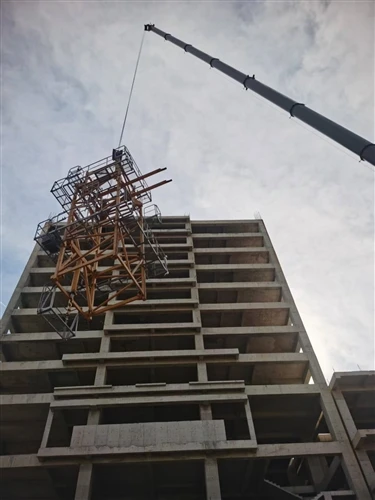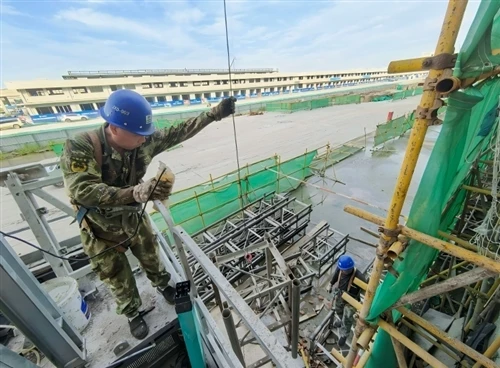


The flat-top tower crane significantly reduces the lifting capacity requirements of the crane equipment needed for tower crane assembly and disassembly.
Because it eliminates the tower head, the flat-top tower crane has a smaller unit mass and a lower installation height, allowing for a maximum installation height that can be more than 10 meters lower than other tower cranes of the same class. When installing the jib of a conventional tower crane, the jib, tie rods, etc., must be connected on the ground before the entire crane is lifted. This places the highest demands on the crane equipment, requiring a large lifting capacity and lifting height. Because after connecting the jib base pins, the jib must be raised significantly to connect the tie rods, which can easily lead to safety accidents. The flat-top tower crane completely eliminates this limitation. Flat-top tower crane jib sections are typically 4m, 5m, or 10m long. Taking a 50m long jib as an example, its maximum unit mass is only about 1/5 of the total jib mass. Compared to assembling and disassembling the jib section by section in the air, the requirements for the crane equipment are greatly reduced, saving on assembly and disassembly costs and making the process safer and faster.
Suitable for multi-tower operations.
Because flat-top tower cranes eliminate the tower head, the height difference between any two cranes operating in a multi-crane configuration can typically be reduced to 3 meters, while for tower cranes with tower heads, the difference can exceed 10 meters. This significant reduction in the overall height of a multi-crane operation with flat-top tower cranes results in advantages such as shorter overall installation time, lower requirements for installation equipment, reduced weight on each crane, and the use of smaller tower body sections and base frames.
Suitable for applications with specific height requirements.
The absence of a tower head in flat-top tower cranes greatly increases the effective hook height and improves space utilization, making them ideal for applications with specific height requirements, such as airport expansion and renovation, construction near airports, construction inside tunnels and factories, and construction under high-voltage lines-tasks that traditional tower cranes with tower heads often struggle to handle.
Suitable for construction applications requiring varying lifting radius.
The unique connection method of the flat-top tower crane's jib sections, along with the absence of a tower head and tie rods, makes the assembly and disassembly of the jib sections extremely simple and safe. During construction, if the jib length needs to be changed (extended or shortened), the entire jib can be added or removed in mid-air without dismantling the entire structure. This need to change the boom's range of motion is frequently encountered in the construction of hyperbolic cooling towers in power plants. After the cooling tower is built, when the tower crane passes through the minimum diameter of the hyperbola, it often requires the removal of some or even most of the jib sections to successfully lower the tower crane. Ordinary tower cranes are limited by tie rods, meaning the jib sections can only be removed from the lifting point, making the removal of the tie rods very difficult. In such cases, the flat-top tower crane allows for convenient and arbitrary jib removal in mid-air.
It facilitates tower crane assembly and disassembly under limited site conditions.
If site conditions restrict the access of a truck crane, the flat-top tower crane is undoubtedly the best solution. Because of its unique jib connection method, the entire jib can be assembled and disassembled section by section in mid-air, and if necessary, sections can be directly taken from and placed on the transport vehicle. Because the unit boom section has a smaller mass, an existing tower crane on the construction site can be used to install a flat-top tower crane next to it. In reality, site constraints are more common when dismantling tower cranes. For example, in high-rise buildings with podiums, the tower crane is often located inside the podium due to various factors. Once the project is completed and the tower crane is being dismantled, the podium restricts access, making it difficult for truck cranes to approach. Dismantling the boom of a regular tower crane is a challenge, but dismantling a flat-top tower crane is much easier in such situations.
The jib steel structure has a long service life and high safety.
Flat-top tower cranes do not have jib tie rods, and their boom cross-section dimensions are usually larger than those of a comparable regular tower crane, especially in height. This results in greater rigidity and less buckling deformation during lifting. Domestic users worry that the lack of tie rods in flat-top tower cranes makes them less safe and reliable, but the opposite is true. According to foreign operators, flat-top tower cranes are more stable than regular tower cranes, especially during slewing or emergency braking. The jib of a flat-top tower crane is only subjected to downward loads, which is simpler; while the jib of a regular tower crane is additionally subjected to horizontal and upward forces generated by the tie rods. Furthermore, the varying positions of the luffing trolley in conventional tower cranes result in significantly different stresses on the same section of the jib. The combined effect causes the main load-bearing members of the jib to be subjected to alternating tensile and compressive stresses, often a major cause of fatigue damage, fracture, and weld cracking. In contrast, the jib of a flat-top tower crane is not subjected to alternating stresses in either the vertical or horizontal directions, greatly improving the service life and safety of the jib steel structure.
The jib offers good applicability and high utilization.
The modular design of the flat-top tower crane jib is crucial. For manufacturers, modularization significantly reduces design and manufacturing costs, thus lowering the price of the flat-top tower crane. For users, it allows for full utilization of the jib's flexibility and adaptability. Jib sections from different levels of flat-top tower cranes in the same series can be used interchangeably; the end sections of larger flat-top tower cranes can be used as intermediate or root sections of smaller tower cranes. This increases the number of jib combinations and improves the jib's applicability and utilization.
Low design costs.
The flat-top tower crane design eliminates the need for designing and calculating the tower head and tie rods. Furthermore, it reduces the number of calculation conditions for the jib and simplifies the mechanical model, significantly decreasing the computational workload and resulting in calculations that more closely approximate actual values. This facilitates modular design and greatly shortens the design cycle. This is also crucial for tower crane manufacturers to cope with the rapidly changing market and meet diverse user requirements.