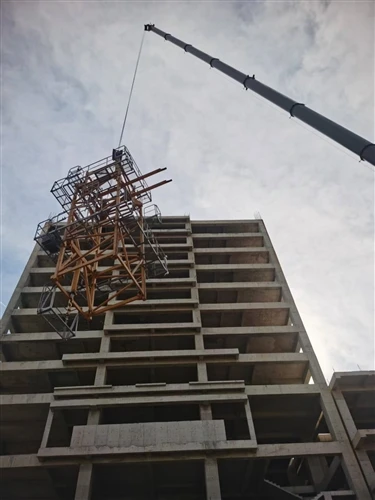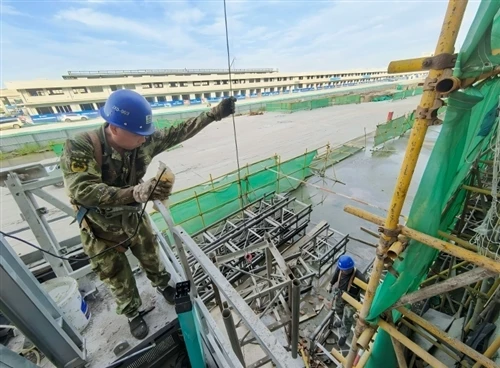


 For cranes of the same tonnage, the total installation time for flat-top models can be nearly one-third shorter than for traditional tower-top models, primarily due to structural design differences:
Elimination of tower top and tie-rod assembly steps
Conventional tower cranes require the separate installation of the tower top, struts, and tie-rods, involving high-altitude alignment and pin fastening, which consumes significant time working at heights. Flat-top cranes lack a tower top and tie-rods; the main jib connects directly to the slewing unit, eliminating the majority of high-altitude assembly tasks.
Fewer machine sections and fewer lifting operations
Conventional tower cranes have fragmented components-tower body, tower top, tie-rods, counter-jib, and lifting jib-requiring multiple lifting stages. Flat-top models feature a more integrated structure with fewer components, significantly reducing the number of crane lifts required and drastically cutting down on off-site assembly time.
 No need to adjust tie-rod pretension; commissioning workload is greatly reduced
After installing a conventional tower crane, the tie-rods must be repeatedly tensioned and the jib's horizontality calibrated-a time-consuming process. Flat-top cranes utilize a rigid jib that is positioned in one go; no tie-rod tensioning is required, and virtually no secondary adjustment is needed after installation.
Lower risk in high-altitude work and smoother workflow
High-altitude alignment and pin insertion are the most time-consuming steps. Flat-top connection points are simple, and pin-hole alignment is straightforward; there is no need for multiple workers to coordinate tensioning tie-rods at heights, allowing the crew to work continuously and effectively reducing downtime caused by waiting.
Faster disassembly process
Disassembling a conventional tower crane involves loosening tie-rods and dismantling the tower top-a cumbersome process. Flat-top cranes allow for the direct separation of the main jib and the slewing platform, increasing disassembly efficiency and shortening the overall schedule for site entry and exit.
In a nutshell
By eliminating the tower top and tie-rod structures, the process reduces high-altitude assembly and commissioning steps as well as the number of lifts required. This cuts the total time for erecting and dismantling the flat-top tower crane by one-third-making it particularly suitable for building construction projects with tight schedules.